Enables and tests the usage of Authorized Integrations to access the package registries.  Specific testing includes:
- Container registry -- automated testing and manual testing
- Generic registry, w/ detailed authorization tests -- automated testing
- Conan registry -- automated testing (uses an "authenticate" endpoint that required updates)
- npm registry -- manual testing with a Forgejo Action publishing packages

For the container & conan registeries, where the client uses an authentication endpoint to request a temporary access token, the expiry of the temporary access token is restricted to the expiry of the authorized integration's JWT for the authorized integration in order to prevent an escalation of privileges.

## Checklist

The [contributor guide](https://forgejo.org/docs/next/contributor/) contains information that will be helpful to first time contributors. All work and communication must conform to Forgejo's [AI Agreement](https://codeberg.org/forgejo/governance/src/branch/main/AIAgreement.md). There also are a few [conditions for merging Pull Requests in Forgejo repositories](https://codeberg.org/forgejo/governance/src/branch/main/PullRequestsAgreement.md). You are also welcome to join the [Forgejo development chatroom](https://matrix.to/#/#forgejo-development:matrix.org).

### Tests for Go changes

- I added test coverage for Go changes...
  - [x] in their respective `*_test.go` for unit tests.
  - [x] in the `tests/integration` directory if it involves interactions with a live Forgejo server.
- I ran...
  - [ ] `make pr-go` before pushing

### Documentation

- [ ] I created a pull request [to the documentation](https://codeberg.org/forgejo/docs) to explain to Forgejo users how to use this change.
- [x] I did not document these changes and I do not expect someone else to do it.

### Release notes

- [x] This change will be noticed by a Forgejo user or admin (feature, bug fix, performance, etc.). I suggest to include a release note for this change.
- [ ] This change is not visible to a Forgejo user or admin (refactor, dependency upgrade, etc.). I think there is no need to add a release note for this change.

Reviewed-on: https://codeberg.org/forgejo/forgejo/pulls/12310
Reviewed-by: Andreas Ahlenstorf <aahlenst@noreply.codeberg.org>
Forgejo's `basic` and `oauth2` authentication methods perform five distinct types of authentication:
- Username and password authentication
- Personal access tokens
- OAuth2 access tokens
- Forgejo Action's `${{ forgejo.token }}` -- task-based static tokens
- Forgejo Action's `${{ env.ACTIONS_RUNTIME_TOKEN }}` JWT, which is the authentication method used for `upload-artifact` (mirroring GitHub's implementation)

`basic` and `oauth2` both supported almost all of these methods, resulting in quite a bit of code duplication between them.  This PR splits personal access tokens into `access_token.go`, Action's task-based tokens into `action_task_token.go`, and Action's JWT tokens into `action_runtime_token.go`.

**Note:** There is one peculiar side-effect that is worth discussing.  Previously, `Authorization: Basic ...` was handled by one complex code path in basic.go, and `Authorization: Bearer ...` was handled by another in oauth2.go, and if authorization failed and a 401 was returned, a single error message would be returned to the user.  Now, as multiple authorization methods may look at `Authorization: Basic ...` and provide their own reason why authorization didn't work, a 401 response has multiple reasons for a lack of authorization listed:

```
401 Unauthorized
...

failure to authenticate with oauth2 access token: not a JWT
Basic authorization is not allowed while having security keys enrolled
access token does not exist [sha: notpassword]
task with token "notpassword": resource does not exist
```

A couple tests have been adapted to check that the result contains their expected response, rather than is equal-to or prefixed-with their expected result.  This is caused by the "auth group" joining together any "invalid credentials" errors, and, to a certain extent it is useful to understand why the authorization request failed.  But it's a bit obscure as well.

## Checklist

The [contributor guide](https://forgejo.org/docs/next/contributor/) contains information that will be helpful to first time contributors. All work and communication must conform to Forgejo's [AI Agreement](https://codeberg.org/forgejo/governance/src/branch/main/AIAgreement.md). There also are a few [conditions for merging Pull Requests in Forgejo repositories](https://codeberg.org/forgejo/governance/src/branch/main/PullRequestsAgreement.md). You are also welcome to join the [Forgejo development chatroom](https://matrix.to/#/#forgejo-development:matrix.org).

### Tests for Go changes

- I added test coverage for Go changes...
  - [ ] in their respective `*_test.go` for unit tests.
  - [ ] in the `tests/integration` directory if it involves interactions with a live Forgejo server.
  - Relying on integration testing for regression checks.
- I ran...
  - [x] `make pr-go` before pushing

### Documentation

- [ ] I created a pull request [to the documentation](https://codeberg.org/forgejo/docs) to explain to Forgejo users how to use this change.
- [x] I did not document these changes and I do not expect someone else to do it.

### Release notes

- [ ] This change will be noticed by a Forgejo user or admin (feature, bug fix, performance, etc.). I suggest to include a release note for this change.
- [x] This change is not visible to a Forgejo user or admin (refactor, dependency upgrade, etc.). I think there is no need to add a release note for this change.

Reviewed-on: https://codeberg.org/forgejo/forgejo/pulls/12236
Reviewed-by: Andreas Ahlenstorf <aahlenst@noreply.codeberg.org>
#12202 began a refactor of Forgejo's authentication implementations by providing structured data on an authentication success.  However, error cases were maintained as-is in that refactor, leaving a complex situation: what does returning an error from an authentication method mean?; does it mean that the authentication failed, or that a server error occurred?  Can another authentication still be tried?

This PR changes authentication methods so that they can return one of four things:
- `AuthenticationSuccess` with an authentication result.
- `AuthenticationNotAttempted` which indicates that no credentials relevant for this authentication method were presented.  If every method returned `AuthenticationNotAttempted`, then you would have an unauthenticated access.
- `AuthenticationAttemptedIncorrectCredential` which indicates that credentials were present and failed validation -- a situation indicating a `401 Unauthorized`.
- `AuthenticationError` which indicates that an internal server error occurred and failed authentication -- indicating a `500 Internal Server Error`.

This paves the way for one more refactor coming next: `basic.go` and `oauth2.go` perform 3-4 different authentications each (access tokens, oauth JWTs, actions tokens, actions JWTs, and username/password).  With the capability to return these more precise responses, these authentication methods can be split up into separate logic that isn't intertwined together.

## Checklist

The [contributor guide](https://forgejo.org/docs/next/contributor/) contains information that will be helpful to first time contributors. All work and communication must conform to Forgejo's [AI Agreement](https://codeberg.org/forgejo/governance/src/branch/main/AIAgreement.md). There also are a few [conditions for merging Pull Requests in Forgejo repositories](https://codeberg.org/forgejo/governance/src/branch/main/PullRequestsAgreement.md). You are also welcome to join the [Forgejo development chatroom](https://matrix.to/#/#forgejo-development:matrix.org).

### Tests for Go changes

- I added test coverage for Go changes...
  - [ ] in their respective `*_test.go` for unit tests.
  - [ ] in the `tests/integration` directory if it involves interactions with a live Forgejo server.
  - Relying on existing test suite, with changes for any compile errors -- the next refactor will simplify the auth methods so that they can be unit tested easily.
- I ran...
  - [x] `make pr-go` before pushing

### Documentation

- [ ] I created a pull request [to the documentation](https://codeberg.org/forgejo/docs) to explain to Forgejo users how to use this change.
- [x] I did not document these changes and I do not expect someone else to do it.

### Release notes

- [ ] This change will be noticed by a Forgejo user or admin (feature, bug fix, performance, etc.). I suggest to include a release note for this change.
- [x] This change is not visible to a Forgejo user or admin (refactor, dependency upgrade, etc.). I think there is no need to add a release note for this change.

Reviewed-on: https://codeberg.org/forgejo/forgejo/pulls/12231
Reviewed-by: Gusted <gusted@noreply.codeberg.org>
Currently authentication methods return information in two forms: they return who was authenticated as a `*user_model.User`, and then they insert key-values into `ctx.Data` which has critical impact on how the authenticated request is treated.  This PR changes the authentication methods to return structured data in the form of an `AuthenticationResult`, with all the key-value information in `ctx.Data` being moved into methods on the `AuthenticationResult` interface.

Authentication workflows in Forgejo are a real mess.  This is the first step in trying to clean it up and make the code predictable and reasonable, and is both follow-up work that was identified from the repo-specific access tokens (where the `"ApiTokenReducer"` key-value was added), and is pre-requisite work to future JWT enhancements that are [being discussed](https://codeberg.org/forgejo/forgejo/issues/3571#issuecomment-13268004).

## Checklist

The [contributor guide](https://forgejo.org/docs/next/contributor/) contains information that will be helpful to first time contributors. All work and communication must conform to Forgejo's [AI Agreement](https://codeberg.org/forgejo/governance/src/branch/main/AIAgreement.md). There also are a few [conditions for merging Pull Requests in Forgejo repositories](https://codeberg.org/forgejo/governance/src/branch/main/PullRequestsAgreement.md). You are also welcome to join the [Forgejo development chatroom](https://matrix.to/#/#forgejo-development:matrix.org).

### Tests for Go changes

- I added test coverage for Go changes...
  - [ ] in their respective `*_test.go` for unit tests.
  - [ ] in the `tests/integration` directory if it involves interactions with a live Forgejo server.
  - All changes, at least in theory, are refactors of existing logic and are not expected to have functional deviations -- existing regression tests are the only planned testing.
- I ran...
  - [x] `make pr-go` before pushing

### Documentation

- [ ] I created a pull request [to the documentation](https://codeberg.org/forgejo/docs) to explain to Forgejo users how to use this change.
- [x] I did not document these changes and I do not expect someone else to do it.

### Release notes

- [ ] This change will be noticed by a Forgejo user or admin (feature, bug fix, performance, etc.). I suggest to include a release note for this change.
- [x] This change is not visible to a Forgejo user or admin (refactor, dependency upgrade, etc.). I think there is no need to add a release note for this change.

Reviewed-on: https://codeberg.org/forgejo/forgejo/pulls/12202
Reviewed-by: Andreas Ahlenstorf <aahlenst@noreply.codeberg.org>
Part of #27065

This reduces the usage of `db.DefaultContext`. I think I've got enough
files for the first PR. When this is merged, I will continue working on
this.

Considering how many files this PR affect, I hope it won't take to long
to merge, so I don't end up in the merge conflict hell.

---------

Co-authored-by: wxiaoguang <wxiaoguang@gmail.com>
1. The "web" package shouldn't depends on "modules/context" package,
instead, let each "web context" register themselves to the "web"
package.
2. The old Init/Free doesn't make sense, so simplify it
* The ctx in "Init(ctx)" is never used, and shouldn't be used that way
* The "Free" is never called and shouldn't be called because the SSPI
instance is shared

---------

Co-authored-by: Giteabot <teabot@gitea.io>
Partially for #24457
Major changes:
1. The old `signedUserNameStringPointerKey` is quite hacky, use
`ctx.Data[SignedUser]` instead
2. Move duplicate code from `Contexter` to `CommonTemplateContextData`
3. Remove incorrect copying&pasting code `ctx.Data["Err_Password"] =
true` in API handlers
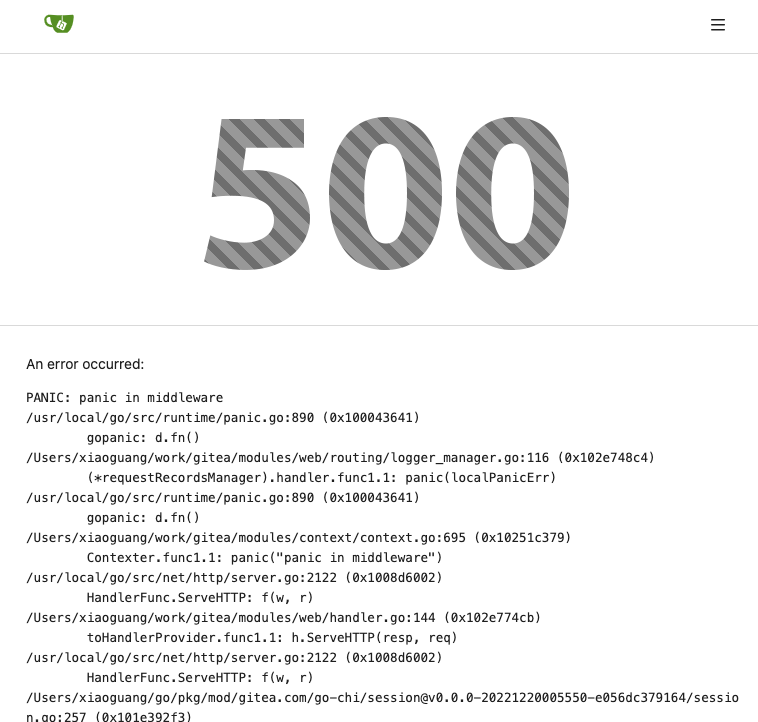
4. Use one unique `RenderPanicErrorPage` for panic error page rendering
5. Move `stripSlashesMiddleware` to be the first middleware
6. Install global panic recovery handler, it works for both `install`
and `web`
7. Make `500.tmpl` only depend minimal template functions/variables,
avoid triggering new panics
Screenshot:
<details>
</details>
This PR changed the Auth interface signature from
`Verify(http *http.Request, w http.ResponseWriter, store DataStore, sess
SessionStore) *user_model.User`
to
`Verify(http *http.Request, w http.ResponseWriter, store DataStore, sess
SessionStore) (*user_model.User, error)`.
There is a new return argument `error` which means the verification
condition matched but verify process failed, we should stop the auth
process.
Before this PR, when return a `nil` user, we don't know the reason why
it returned `nil`. If the match condition is not satisfied or it
verified failure? For these two different results, we should have
different handler. If the match condition is not satisfied, we should
try next auth method and if there is no more auth method, it's an
anonymous user. If the condition matched but verify failed, the auth
process should be stop and return immediately.
This will fix#20563
Co-authored-by: KN4CK3R <admin@oldschoolhack.me>
Co-authored-by: Jason Song <i@wolfogre.com>
Change all license headers to comply with REUSE specification.
Fix#16132
Co-authored-by: flynnnnnnnnnn <flynnnnnnnnnn@github>
Co-authored-by: John Olheiser <john.olheiser@gmail.com>
The recovery, API, Web and package frameworks all create their own HTML
Renderers. This increases the memory requirements of Gitea
unnecessarily with duplicate templates being kept in memory.
Further the reloading framework in dev mode for these involves locking
and recompiling all of the templates on each load. This will potentially
hide concurrency issues and it is inefficient.
This PR stores the templates renderer in the context and stores this
context in the NormalRoutes, it then creates a fsnotify.Watcher
framework to watch files.
The watching framework is then extended to the mailer templates which
were previously not being reloaded in dev.
Then the locales are simplified to a similar structure.
Fix#20210Fix#20211Fix#20217
Signed-off-by: Andrew Thornton <art27@cantab.net>
This PR extends #16594 to allow LDAP to be able to be set to skip local 2FA too. The technique used here would be extensible to PAM and SMTP sources.

Signed-off-by: Andrew Thornton <art27@cantab.net>
`models` does far too much. In particular it handles all `UserSignin`.

It shouldn't be responsible for calling LDAP, SMTP or PAM for signing in.

Therefore we should move this code out of `models`.

This code has to depend on `models` - therefore it belongs in `services`.

There is a package in `services` called `auth` and clearly this functionality belongs in there.

Plan:

- [x] Change `auth.Auth` to `auth.Method` - as they represent methods of authentication.
- [x] Move `models.UserSignIn` into `auth`
- [x] Move `models.ExternalUserLogin`
- [x] Move most of the `LoginVia*` methods to `auth` or subpackages
- [x] Move Resynchronize functionality to `auth`
  - Involved some restructuring of `models/ssh_key.go` to reduce the size of this massive file and simplify its files.
- [x] Move the rest of the LDAP functionality in to the ldap subpackage
- [x] Re-factor the login sources to express an interfaces `auth.Source`?
  - I've done this through some smaller interfaces Authenticator and Synchronizable - which would allow us to extend things in future
- [x] Now LDAP is out of models - need to think about modules/auth/ldap and I think all of that functionality might just be moveable
- [x] Similarly a lot Oauth2 functionality need not be in models too and should be moved to services/auth/source/oauth2
  - [x] modules/auth/oauth2/oauth2.go uses xorm... This is naughty - probably need to move this into models.
  - [x] models/oauth2.go - mostly should be in modules/auth/oauth2 or services/auth/source/oauth2
- [x] More simplifications of login_source.go may need to be done
- Allow wiring in of notify registration -  *this can now easily be done - but I think we should do it in another PR*  - see #16178
- More refactors...?
  - OpenID should probably become an auth Method but I think that can be left for another PR
  - Methods should also probably be cleaned up  - again another PR I think.
  - SSPI still needs more refactors.* Rename auth.Auth auth.Method
* Restructure ssh_key.go

- move functions from models/user.go that relate to ssh_key to ssh_key
- split ssh_key.go to try create clearer function domains for allow for
future refactors here.

Signed-off-by: Andrew Thornton <art27@cantab.net>